

Types of Stem Cells: Classification, Uses and Key Differences
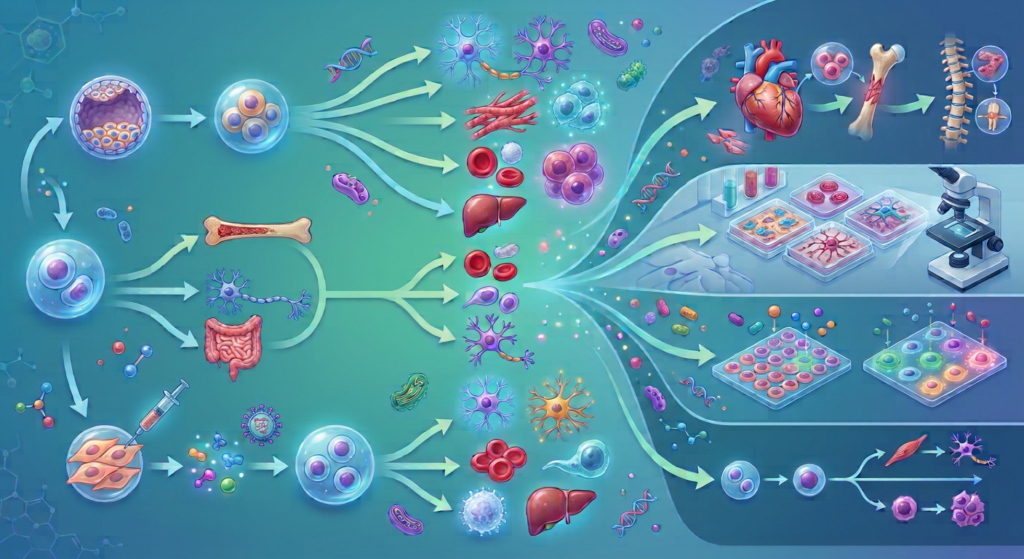
Stem cells are one of the most extensively studied cells in today’s medical research. They possess special properties, different from those of many cells in the body. They can divide and multiply and can respond to the right conditions in their biological environment to grow into specialised cells. They are significant for their role in normal tissue maintenance, disease research, regenerative medicine and some established medical treatments.
Stem cells are not a single type of cell, however. They can be divided by scientists into several categories. Cell classification can be done by cell source, the cell types that can be formed, or by research and medical use. It is critical to be aware of these categories when talking about stem cell research or any cell-based therapy.
At Njinsky Medical Centre, clear medical information is an important part of helping patients understand their options. Stem cell science is complex. Not every stem cell type has the same properties or the same clinical applications. Some uses are well established while others remain under investigation. This guide explains the major categories of stem cells and the differences between them.
What Are Stem Cells?
Stem cells are cells that have two important characteristics. They can produce more stem cells through self-renewal. They can also differentiate into more specialised cells under appropriate conditions. The extent of this differentiation ability varies between stem cell populations.
This ability is known as potency. Potency describes how many different cell types a stem cell can potentially produce. Some cells have very broad developmental potential. Others are restricted to producing cells within a particular tissue or cell lineage.
For this reason, understanding the types of stem cells requires looking at both their origin and their developmental potential.
1. Totipotent Stem Cells
Totipotent cells have the broadest developmental potential. They can contribute to the formation of the embryo as well as extraembryonic tissues. These extraembryonic tissues include structures that support early development.
The fertilised egg, known as a zygote, is considered totipotent. Cells produced during the earliest stages of embryonic development also have this broad potential. As development continues, cells become progressively more specialised and their developmental potential becomes more restricted.
Totipotency is therefore mainly associated with the earliest stages of development. It is different from pluripotency. Pluripotent cells can produce many specialised cells of the body but do not have the same ability to contribute to extraembryonic tissues.
Key features of totipotent cells
- They have the broadest developmental potential.
- They can contribute to embryonic tissues.
- They can contribute to extraembryonic tissues.
- They occur during the earliest stages of development.
- They are not the primary cell type used in routine clinical stem cell treatments.
2. Pluripotent Stem Cells
Pluripotent stem cells can give rise to cells derived from all three primary embryonic germ layers (ectoderm, mesoderm and endoderm). Over time these layers come to form many different tissues and organs in the body.
Embryonic stem cells are one of the most significant examples of pluripotent stem cells. They are taken from the inner cell mass of early embryos and can be cultured in the laboratory using established protocols.
Researchers can use pluripotent stem cells to study how cells develop and specialise, which makes them important. Researchers can also study the effects of certain diseases on various cells. Such cells can thus be used in disease modelling, drug research and regenerative medicine research.
Important point
A pluripotent cell can potentially develop into any cell type of the body, but this does not happen automatically. Biological signals and laboratory conditions direct differentiation. These processes must be carefully monitored by scientists when attempting to create specialised cells.
3. Embryonic Stem Cells
Embryonic stem cells are one of the most well-known examples of pluripotent stem cells. They come from the inner cell mass of the early embryo. When conditions are right in the laboratory, they can retain the capacity to renew themselves continuously and to turn into various types of specialised cells.
Researchers are investigating embryonic stem cells to gain insight into early human development and cell differentiation. They could also be used in the study of diseases and possible regeneration strategies.
There are, however, certain scientific and ethical issues in embryonic stem cell research. Unlike blood-forming stem cells, which have an established use in haematopoietic stem cell transplantation, embryonic stem cells are not used for that purpose.
This is a significant difference. Please be aware that a research application does not necessarily mean a proven treatment.
4. Adult or Somatic Stem Cells
Also called somatic stem cells, adult stem cells are cells present in the body that can form the specialised cells of the tissue in which they reside. They can be found in tissues and organs around the body. Their function is usually that of maintenance and repair of the tissue in which they reside.
Pluripotent stem cells are typically less differentiated than these cells. Most adult stem cells are multipotent. This allows them to give rise to a number of related classes of cells in a specific tissue or lineage.
For instance, blood-forming stem cells can produce various kinds of blood cells. These include red blood cells and a number of immune cell types. Normally they do not produce all the specialised cells present in the body.
There are several tissues where adult stem cells have been found. They have different properties that vary significantly, depending on their site and biological role.
5. Haematopoietic Stem Cells
Blood-forming stem cells are called haematopoietic stem cells. They are especially significant in medicine because they can give rise to all types of blood cells.
These cells are mainly in the bone marrow. They may also be obtained from the peripheral (circulating) blood under certain medical indications. In some stem cell transplantation situations, cord blood is also used.
Haematopoietic stem cell transplantation is an established medical procedure for certain blood cancers and blood and immune disorders. Treatment includes replacing or restoring the blood-forming (haematopoietic) stem cell system after it has been destroyed or damaged by disease, conditioning, or other specialised treatment.
Haematopoietic stem cells are one of the most important types of stem cells in today’s medicine due to their clinical significance.
6. Mesenchymal Stem or Stromal Cells
Mesenchymal stem/stromal cells are another cell type that has been widely investigated in the field of regenerative medicine. They have been studied in connection with bone, cartilage, connective tissue and immune processes.
However, the terminology for these cells can be complicated. The term “mesenchymal stem cell” is not used identically by all researchers. The term “mesenchymal stromal cells” is, therefore, used in some scientific literature.
In December 2024, the US FDA approved the first mesenchymal stromal cell therapy, for steroid-refractory acute graft-versus-host disease in children. These cells are still being researched for additional uses. The type of evidence varies by disease, cell preparation, mode of administration, treatment protocol and study design.
It is important that patients do not assume that research of mesenchymal cells implies that a treatment is available or appropriate for all conditions.
7. Induced Pluripotent Stem Cells
Induced pluripotent stem cells are referred to as iPSCs. These are produced by reprogramming a mature cell to a pluripotent state.
For instance, it can be possible to take specialised adult cells and alter their state through specific reprogramming techniques. The resulting cells can then be examined as pluripotent stem cells.
iPSCs have become an important research tool. They are used by scientists to model diseases and to study cellular processes. They may also aid researchers in investigating possible ways to replace damaged cells.
An advantage is that iPSCs can be created from adult cells, instead of being taken directly from an embryo. Making and managing these cells is a complex process in the lab, however.
Researchers are still investigating the potential of iPSCs in various therapies and how well they can be used safely and effectively. In 2026, Japan granted conditional, time-limited approval to the first iPSC-derived therapies, for severe ischaemic heart failure and Parkinson’s disease, but their long-term safety and effectiveness are still being assessed.
Understanding Stem Cells by Their Potency
Another way to understand stem cells and types is to classify them according to potency.
Potency | Developmental ability |
Totipotent | Embryonic and extraembryonic tissues |
Pluripotent | Cells from the three embryonic germ layers |
Multipotent | Multiple related cell types |
Oligopotent | A smaller group of related cell types |
Unipotent | Primarily one specialised cell type |
Different Kinds of Stem Cells: How Do They Differ?
When reviewing the different kinds of stem cells, several factors should be considered.
1. Source
Stem cells may come from embryos, adult tissues, blood, bone marrow, umbilical cord blood, or laboratory-reprogrammed adult cells.
2. Potency
Some stem cells can produce a broad range of cell types. Others are limited to specific tissue lineages.
3. Function
Some stem cells naturally support tissue maintenance. Others are mainly studied in laboratory settings.
4. Clinical use
Not every stem cell population has an established therapeutic application. Some are used in accepted medical procedures while others remain under research.
5. Laboratory requirements
Different stem cells require different methods for collection, culture, expansion, storage, and differentiation.
Final Thoughts
Understanding the types of stem cells requires more than memorising a list of names. Stem cells differ in their origin, potency, biological behaviour, and potential applications. At Njinsky Medical Centre, patient education remains important when discussing stem cell-based approaches. Understanding the science can help patients ask better questions and have more informed discussions with qualified medical professionals. Stem cell research continues to evolve, and responsible medical decisions should be based on appropriate assessment and reliable scientific evidence.
Explore Stem Cell Treatment Options at Njinsky Medical Centre.

Njinsky Medical Center
At Njinsky, we specialize in cutting-edge stem cell treatments to heal untreatable ailments, regenerate cells, and revitalize the body and brain. With expert research and care, we redefine age, disease, and pain, offering a healthier, pain-free future through regenerative medicine.
Contact Information
Mesenchymal Stem Cells: Benefits, Uses & Medical Research
admin
November 13, 2026