

Mesenchymal Stem Cells: Benefits, Uses & Medical Research
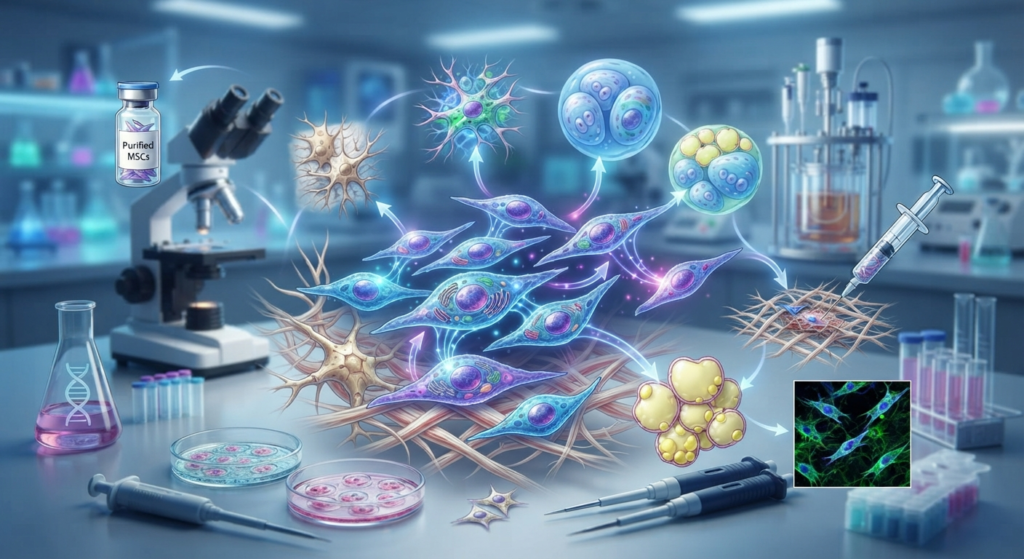
The use of stem cells is now a significant field in contemporary medicine. Researchers are examining various types of cells and their interactions to better understand the repair of tissue and control of inflammation. Mesenchymal stem cells are one of these populations that have been extensively studied in science. Their applications have been explored in fields like tissue regeneration, immune system modulation, musculoskeletal disorders, and regenerative medicine.
But what are mesenchymal stem cells? The answer is not as straightforward as you may think. The term has been widely adopted in the scientific literature and clinical research. But concerns have been expressed regarding the definition and characterisation of these cells. Because several cell populations are labelled as MSCs but lack the characteristics of a stem cell, the term mesenchymal stromal cells (also abbreviated MSCs) is often used instead.
Patient education is a key factor in addressing responsible conversations about cell-based medicine at Njinsky Medical Centre. The biological properties of mesenchymal stem cells are of great promise. Promising research does not, however, imply that a treatment is established for all the diseases. By knowing where they come from, their characteristics, and the kinds of things they can do in some situations and not in others, patients can have a more informed perspective on this field and be more realistic.
What is a Mesenchymal Stem Cell?
MSCs are often referred to as multipotent cells that can be isolated from a variety of tissues. These include bone marrow and adipose tissue. This type of cell population is also available from umbilical cord and placenta. These cells have been demonstrated to have the capacity to differentiate into some specialised cell types under laboratory conditions.
The word “mesenchymal stem cell” is a very common one. The term mesenchymal stromal cell was, however, proposed by the International Society for Cellular Therapy as more scientifically accurate. This is due to the fact that MSCs are not uniform and that there is less evidence supporting the concept of their role as true stem cells in the body than the popular term implies.
That is why the terms mesenchymal stem cells and mesenchymal stromal cells are used interchangeably. In scientific publications, they’re often referred to as MSCs.
Where Do Mesenchymal Stem Cells Come From?
Source | Research interest |
Bone marrow | One of the established sources studied for MSC research |
Adipose tissue | Contains stromal cell populations that can be isolated for research |
Umbilical cord | Studied as a source of MSC populations |
Placenta | Investigated for cell-based research |
Other connective tissues | Studied in specific research settings |
What are the Differences between Mesenchymal Stem cells and other Stem Cells?
The stem cells do not constitute a single homogeneous population. Stem cells vary in their developmental ability.
Pluripotency is the characteristic of embryonic stem cells. They can develop into cell types derived from all three embryonic germ layers. In general, the potential of adult tissue-specific stem cells is lower.
MSCs are commonly referred to as multipotent stromal cells. Laboratory studies show that they can be induced to change their direction to become fat-forming, cartilage-forming and bone-forming cells under the right conditions.
This does not mean that injected MSCs immediately switch to the job of replacing tissue within the patient. Recent studies indicate they also have biological properties of signalling and interactions with adjacent cells.
The Potential of Mesenchymal Stem Cells
The ability to differentiate is one of the reasons MSCs attract scientific attention.
MSC populations can be stimulated to exhibit several connective tissue lineage characteristics under laboratory conditions.
These commonly include:
- Cells with osteogenic properties, which relate to bone formation.
- Cells that have chondrogenic properties, which relate to cartilage formation.
- Cells with adipogenic properties, which relate to fat formation.
These characteristics are some of the properties that in the past have been used to define MSC in laboratory studies.
However, tissue regeneration in patients is not guaranteed and should not be confused with laboratory differentiation. The human body is a much more complex system than any controlled laboratory. This is especially relevant with commercial stem cell treatments.
What is the Mechanism of Action of Mesenchymal Stem Cells?
A few mechanisms have been studied that explain how MSCs can modulate tissues.
Paracrine signalling is one of the areas of interest. MSCs can produce biological factors that can communicate with adjacent cells. These signals can affect inflammation, immune responses, blood vessel growth and tissue environments.
Previous theories have been primarily centred on the idea of MSCs migrating to damaged tissues in order to directly replace damaged cells. More recent studies have emphasised the signalling and immunomodulatory properties of MSCs.
How this happens is still being studied. These effects can vary depending on the disease, tissue origin, method of preparation, route of administration, and biological environment of the patient.
Important distinction
MSC research does not imply that MSCs simply replace affected cells.
Their possible effects may involve interactions between administered cells and the patient’s own cells.
MSCs and the Immune System
Immune regulation is another key field of MSC research.
The interactions between MSCs and immune cells and inflammatory pathways have been studied by scientists. Laboratory and preclinical experiments have indicated that MSCs may modulate immune responses via both secreted and cell-to-cell interactions.
This has inspired research into potential use in inflammatory and immune related diseases.
Biological activity is not an indicator of clinical effectiveness. Properly designed clinical studies must still be done to evaluate a treatment.
This is particularly relevant as the characteristics of different MSC products can vary a great deal.
Potential Areas of Mesenchymal Stem Cell Research
Research area | Why MSCs are being studied |
Bone and cartilage | Potential effects on connective tissue and inflammatory environments |
Immune disorders | Immunomodulatory properties |
Inflammatory conditions | Possible influence on inflammatory pathways |
Cardiovascular research | Potential tissue and signalling effects |
Neurological research | Investigation of biological and immunomodulatory effects |
Gastrointestinal disorders | Research into inflammatory and tissue-related conditions |
Wound healing | Investigation of tissue repair mechanisms |
Mesenchymal Stem Cells in Regenerative Medicine
Regenerative medicine aims to understand how damaged or diseased tissues might be repaired or supported.
MSCs are frequently discussed within this field because of their ability to interact with surrounding tissues and their potential immunomodulatory and signalling properties.
Researchers have explored whether MSCs can support tissue environments rather than simply becoming replacement tissue themselves. This has changed how scientists understand their potential mechanisms.
Despite considerable research, many questions remain about how MSC-based treatments work in humans. Reviews of the field have noted differences in cell products, study designs, doses, delivery methods, and patient populations.
This makes it difficult to apply results from one study to every MSC-based treatment.
Final Thoughts
MSCs have emerged as a key target in the field of regenerative medicine and cell-based research. They have been examined for their differentiation properties and their interactions with surrounding tissues and the immune system. They have been investigated for their potential function in tissue repair, inflammation, immune regulation and other areas.
But mesenchymal stem cells cannot be defined simply as cells that repair damaged tissue. They are a complex and heterogeneous cell population. The word itself has changed and many researchers use the term mesenchymal stromal cells to describe these cells more accurately.
Information is key at Njinsky Medical Centre when it comes to cell-based medicine. Patients need to comprehend where the cells are coming from, what their characteristics are, how it is supported by clinical trial evidence and the risks, both known and unknown, associated with the proposed treatment. While research continues to explore the potential of MSCs, every proposed use will require its own evidence to be tested rather than relying simply on the promises of stem cell science.
It is important to distinguish between the potential of science and clinical benefit if responsible medical care is to be conducted. That distinction can help patients make informed health decisions and be aware of the state of mesenchymal stem cell research.
Discover More About Stem Cell Treatment Options Available to UK Patients.

Njinsky Medical Center
At Njinsky, we specialize in cutting-edge stem cell treatments to heal untreatable ailments, regenerate cells, and revitalize the body and brain. With expert research and care, we redefine age, disease, and pain, offering a healthier, pain-free future through regenerative medicine.
Contact Information
Types of Stem Cells: Classification, Uses and Key Differences
admin
November 4, 2026